
Leave A Message
If you are interested in our products and want to know more details,please leave a message here,we will reply you as soon as we can.



Ceiling fans are widely used in homes, offices, and commercial spaces because of their energy efficiency and reliable performance. However, when a ceiling fan starts running slower than usual, struggles to change speeds, or stops working entirely, one common cause is a faulty ceiling fan capacitor.
In this article, we’ll explain when to replace a ceiling fan capacitor, how to recognize the warning signs, and why CBB61 ceiling fan capacitors are the most common solution. This guide is written for both end users and buyers looking for clear technical insight.
A ceiling fan capacitor is a key electrical component that helps:
Start the fan motor
Maintain stable rotation
Control fan speed
Reduce vibration and noise
Most single-phase AC ceiling fans use a CBB61 fan capacitor, which is designed specifically for motor running and speed control at 50/60Hz.
Without a properly functioning capacitor, the motor cannot generate enough phase shift to run efficiently.
If you notice any of the following issues, the capacitor should be checked first:
Even at the highest speed setting, the fan rotates slowly. This usually indicates the capacitor’s capacitance value has dropped over time.
A humming sound without rotation often means the capacitor can no longer provide enough starting torque.
If speed changes no longer work properly or only one speed is functional, the internal capacitor may be partially damaged.
If you have to manually push the blades to get the fan moving, the capacitor is likely weak or failing.
In some cases, a burned or open capacitor will prevent the fan from operating at all.
Ceiling fan capacitors are designed for long service life, but several factors can shorten their lifespan:
Long-term high temperature operation
Voltage fluctuations
Poor ventilation inside the fan housing
Low-quality capacitor materials
Aging and dielectric degradation
Typically, a ceiling fan capacitor may last 5–10 years, depending on usage and environment.
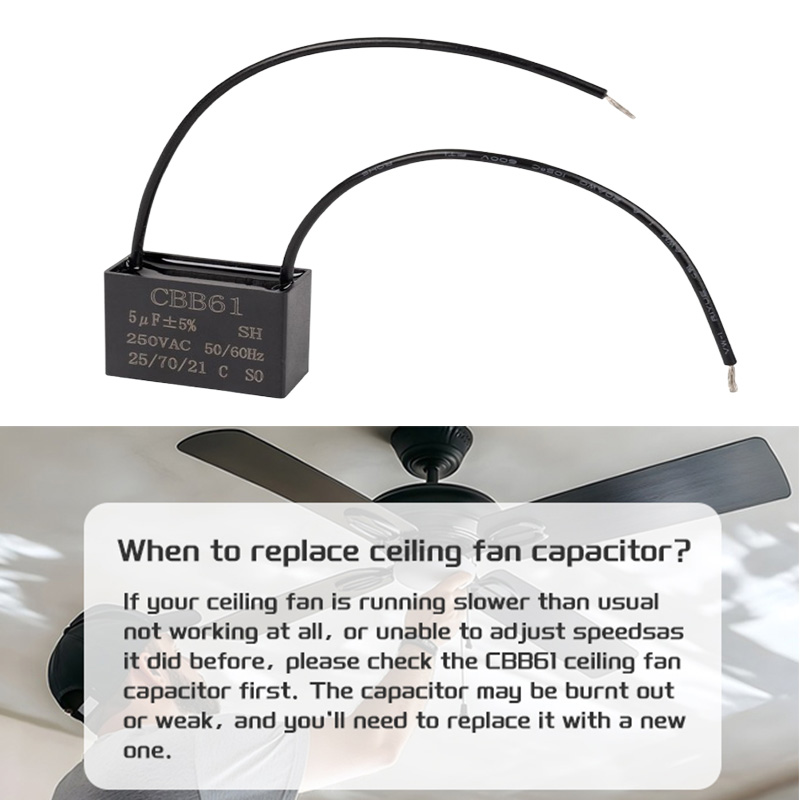
The CBB61 capacitor is the most widely used capacitor type for ceiling fans because it offers:
Stable performance for AC motor running
Compact rectangular or oval housing
Polypropylene film dielectric for reliability
Low loss and long service life
Multiple capacitance combinations in one unit
Common capacitance values include 1.5µF, 2µF, 2.5µF, 3µF, 4µF, 5µF, with rated voltages typically 250VAC / 400VAC / 450VAC.
When replacing a ceiling fan capacitor, always match:
Capacitance (µF value) – must match the original
Rated Voltage – equal or higher than the original
Frequency – 50/60Hz compatible
Size and lead length – must fit inside the fan housing
Using an incorrect capacitor may cause motor overheating, noise, or reduced lifespan.
Yes. In most cases, replacing a faulty CBB61 capacitor will:
Restore normal fan speed
Improve starting performance
Reduce abnormal noise
Extend the overall life of the ceiling fan
Replacing a capacitor is often more cost-effective than replacing the entire fan.
If your ceiling fan is running slowly, making noise, or failing to start, a faulty ceiling fan capacitor is often the root cause. Identifying the problem early and replacing it with the correct CBB61 capacitor can quickly restore performance and extend the life of your fan.
For manufacturers, distributors, and importers, choosing high-quality CBB61 capacitors ensures stable fan operation and long-term reliability.



 IPv6 network supported
Leave A Message
Scan to Wechat :

Scan to WhatsApp :

 Tel :
Tel :  Email :